
TARARA GUIDE
Small Bathroom Tile Ideas That Actually Work

The right size, colour, grout and layout to make a small bathroom feel bigger — from a master tiler.
A small bathroom doesn’t have to feel small. The tiles you choose, and the way they’re laid, make an enormous difference to how open a compact space feels — and most of it comes down to a few simple principles, not expensive tricks. The short version: fewer grout lines, lighter tones, and a layout that keeps the eye moving. Here’s how to put that into practice, from a tiler who’s made plenty of tight Auckland bathrooms feel twice their size.
Go bigger, not smaller, with your tiles
It sounds backwards, but large-format tiles usually make a small bathroom feel bigger, not busier. The reason is grout lines: lots of small tiles create a grid of lines that visually chops the space up, while fewer, larger tiles mean fewer lines and a calmer, more continuous surface. Big tiles also mean fewer grout joints to clean — a real bonus in a hard-working little room.
The trade-off is that large-format tiles are unforgiving to lay. They need a genuinely flat substrate and precise setting, or you get lippage (edges that don’t sit flush) and uneven joints that show badly in a small space. This is exactly where craftsmanship earns its money — it’s a core part of what we do on every bathroom.
Keep it light, and keep it tonal
Two colour principles do most of the heavy lifting in a small bathroom:
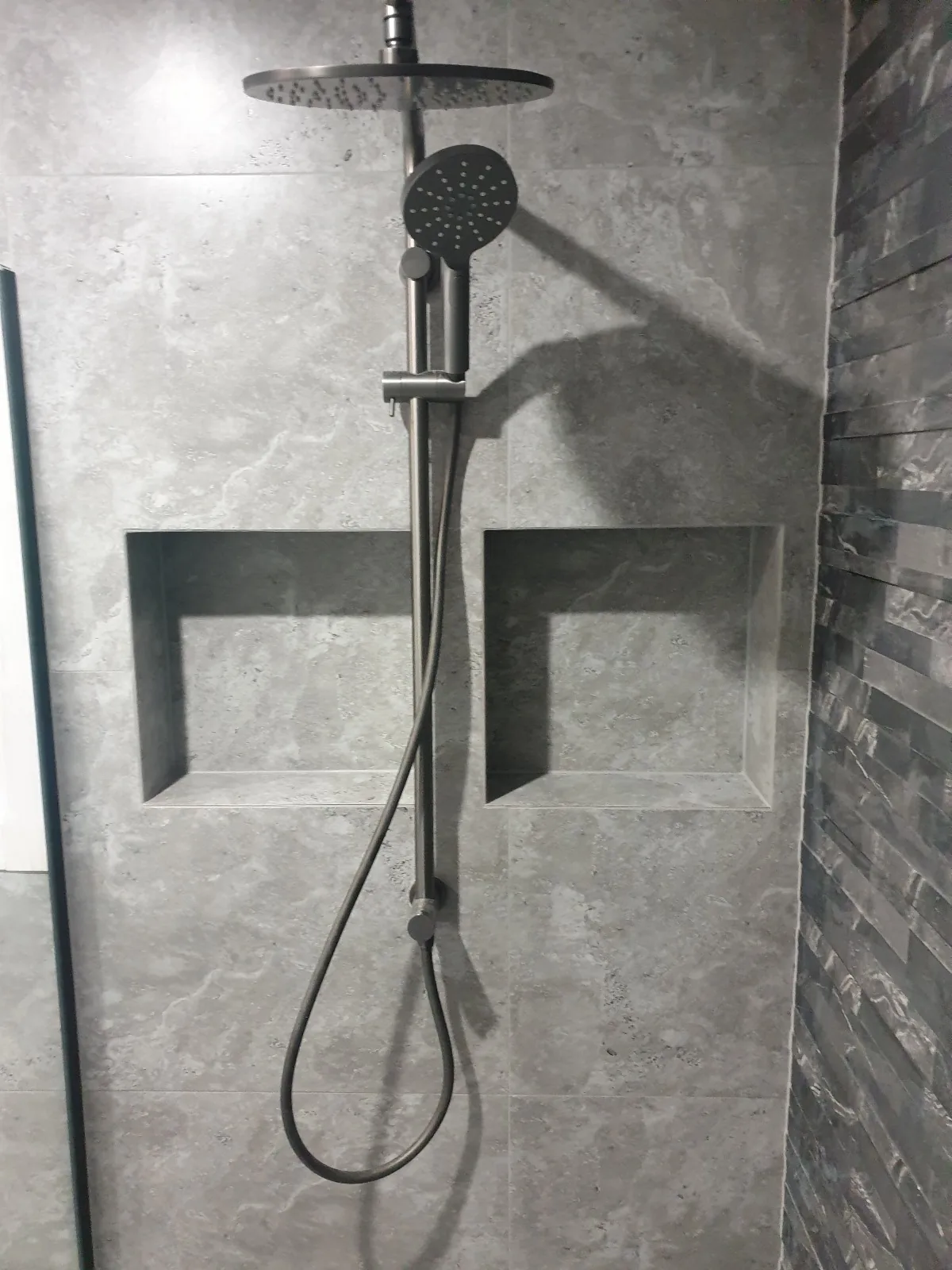
- Lighter tones bounce light around. Pale tiles — soft whites, warm neutrals, light stone looks — reflect the light you’ve got and make walls feel like they’re further away. Darker schemes can look stunning, but they close a small room in unless the lighting is very good.
- Match your grout to your tile. A grout colour close to the tile makes the whole surface read as one, so the eye isn’t drawn to a grid of contrasting lines. Tonal grout is one of the simplest ways to make a small bathroom feel larger and less busy. (Save the contrasting grout for feature areas where you want the pattern to show.)
Finish matters too. A slight sheen on the wall tiles lifts the available light a little further, while a matt floor keeps things underfoot calm and slip-resistant — a small contrast in finish rather than in colour. It is the kind of detail that does not shout, but it is part of why a well-put-together small bathroom feels considered instead of cramped.
Marko’s tip: “People think a small bathroom needs small tiles. It’s the opposite. Big tiles, a light colour and grout that matches — that’s the combination that opens a tight room up. Then it just has to be laid dead flat, because in a small space every imperfect line is right there at eye level.”
Take the tiling up — and let the eye travel
Breaks and boundaries make a room feel smaller, so anything that reduces them helps:
- Tile floor-to-ceiling on at least the wet walls. A full-height run reads as one clean surface rather than a tiled band with a painted gap above it, and it makes the ceiling feel higher.
- Carry one tile through where you can, rather than switching materials every half metre. Continuity reads as space.
- Draw the eye up with a vertical feature — a tiled niche, a vertical stack, or a single feature line — so the room feels taller.
The exception: where small tiles still win
There’s one place small tiles earn their keep even in a compact bathroom — the shower floor. Mosaics and small-format tiles suit a shower base because the many grout lines add grip underfoot, and small pieces sit neatly into the falls that drain the water away. A common, effective look in a small bathroom is large-format tiles on the walls and floor, with a mosaic shower base as a subtle contrast. Our mosaic and feature tiling page shows how that detail comes together.
Small-space details worth the money
A few finishing choices punch above their weight in a compact bathroom:
- Recessed niches instead of shelves. A tiled niche in the shower wall gives you storage without anything sticking out into an already tight space.
- Underfloor heating. In a small room the cost of underfloor heating is lower than in a big one, and warm tiles underfoot transform how a compact bathroom feels to use — no bulky heater on the wall taking up space.
- Slip-resistant floor tiles. Small bathrooms get wet fast; a floor tile with the right finish keeps it safe without looking clinical.
- A frameless or clear shield. Not tiling, but it matters — anything that lets you see the full run of tile makes the room feel bigger than a solid screen would.
Get the setting right and it all pays off
Every one of these ideas depends on the tiling being done well. Large-format tiles laid dead flat, grout lines kept fine and even, falls that actually drain, and waterproofing that lasts — in a small bathroom, where everything is at arm’s length, precision is the whole game. If you’re planning a compact bathroom in Auckland, tell us about it and we’ll give you honest advice on tiles, layout and what will make the space feel its biggest — then tile it to a standard you’ll still love in twenty years.
Frequently asked questions
Do large tiles really make a small bathroom look bigger?
Generally, yes. Fewer, larger tiles mean fewer grout lines, so the surface reads as calmer and more continuous, which makes a small room feel more open. The catch is that large-format tiles need a flat substrate and skilled setting to look right.
What colour tiles are best for a small bathroom?
Lighter tones usually work best because they reflect light and make walls feel further away. Darker schemes can look great but tend to close a small room in unless the lighting is strong.
Should the grout match the tile in a small bathroom?
For an open feel, yes — a grout colour close to the tile makes the whole wall read as one surface rather than a grid of lines. Contrasting grout is better saved for a feature area where you want the pattern to show.
Can you use large-format tiles in a small bathroom?
Absolutely, and they’re often the best choice. They just have to be laid on a properly prepared, flat surface with precise setting, or uneven edges will show — which is exactly where an experienced tiler makes the difference.
Are mosaics a good idea in a small bathroom?
On the shower floor, yes — the extra grout lines add grip and the small pieces sit into the drainage falls neatly. Elsewhere in a small bathroom, larger tiles usually keep the space feeling more open.
Keep reading
More practical tiling guides from Tarara Tiling
Large-Format Tiles: Pros & Cons
The honest trade-offs, and why the installer matters most.
Read the guide →Porcelain vs Ceramic Tiles
Which tile actually suits your project, room by room.
Read the guide →Bathroom Renovation: The Complete Tiling Guide
How the tiling fits into a full bathroom renovation, step by step.
Read the guide →Want more like this?
Once a season we send one genuinely useful, expert tiling tip straight to your inbox — on bathrooms, waterproofing, outdoor tiling and getting a finish that actually lasts. Practical, current and checked by a working tiler. No spam, no sales pitch.
We email about tiling advice only. Unsubscribe anytime — your details stay private (NZ Privacy Act).Almost there — check your inbox to confirm your subscription.
Planning a small bathroom in Auckland?
Tell us about your space and we’ll give you honest advice on tiles, colour and layout to make it feel its biggest — plus a free, no-obligation quote and tiling done to last.
PS3-approved waterproofing, a 10-year workmanship guarantee, and a 5.0 rating across 20+ Google reviews.